
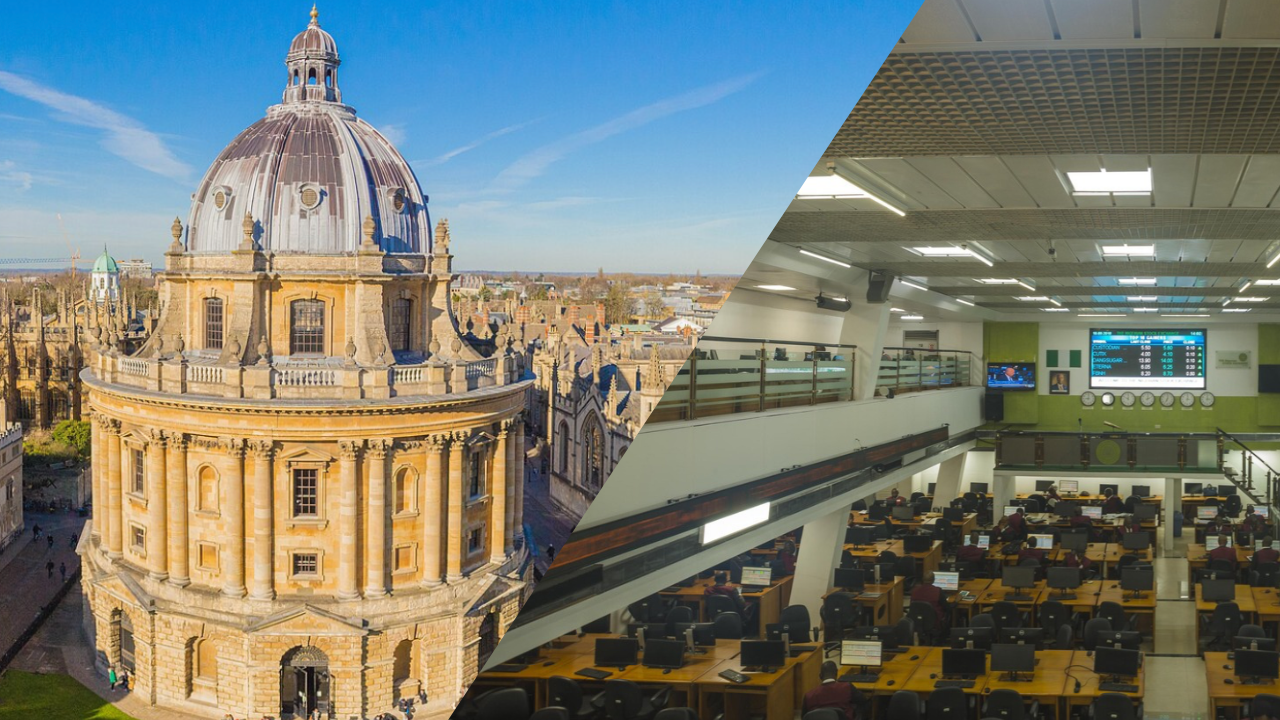
As filming of the fifth and final season of the HBO hit drama Industry begins, the co-creators Mickey Down and Konrad Kay sat down with the Oxford Political Review to discuss the show’s complex engagement with capitalism, the persistence of class divides as a defining feature of British life, and how their time at Oxford shaped the series. Down and Kay met as undergraduate students at Oxford and both went on to brief careers in banking in London before turning to screenwriting. Industry, which premiered in 2020, follows the professional and private lives of recent university graduates navigating the fictional London bank Pierpoint & Co. The show pulsates with adrenaline-fueled ambition as the young bankers strive and backstab to carve out a place for themselves in the elite hypercompetitive world of finance. As Industry has grown in popularity, so has its scope. The show’s aperture has widened from examining the dynamics of the trading floor to tackling themes including the ESG movement, the British aristocracy, financial journalism, and right-wing political movements.
The show can be read as both trumpeting capitalism’s triumphs and exposing the depravity of its excesses. In Season 2, the senior banker Eric Tao questions whether his life’s work in finance amounted to anything at all: ‘What did I build? What did I make? What did I leave? Do I believe in any of it now?’ Just several episodes later, Eric delivers a sermon on the virtues of capitalism to Pierpoint employees despite impending mass layoffs: ‘Orderly financial exchange is the basis of harmony. Money tames the beast. Money is peace. Money is civilisation.’ Main characters move through the world of Industry aware of finance’s societal contradictions, yet are often unburdened by moralistic concerns, viewing the sector as a vehicle to pursue unrelenting ambition. Watching Industry, one is left with a sense that the traits that make a successful financier – rapacious, transactional, and incessantly driven for more – prove destructive should they bleed into other facets of modern life, from personal connections to family relations to politics.
Down and Kay told the OPR that they didn’t set out to write a straightforward critique of the finance industry. Rather, they sought to render the world as authentically as possible and let audiences arrive at their own judgements. As Kay put it, ‘It’s impossible to make anything didactic and truly entertaining.’ Turning to Oxford, the creators emphasise their undergraduate years as foundational to the show’s central interests, describing the university as a breeding ground for the ambitious and factory for the powerful who continue to shape the future of Britain. Finally, they elaborate on the continued taboo of discussing class anxiety despite regarding class divides as ‘one of the most powerful forces determining peoples’ futures.’ The following conversation has been edited for length and clarity.
Michael Wakin (OPR): There is this long lineage of depictions of the finance industry that are, on the one hand, critical of its capacity to corrupt, and, on the other hand, get adopted by the finance industry itself as almost badges of honour. I’m thinking of Liar’s Poker by Michael Lewis, Tom Wolfe’s The Bonfire of the Vanities, or Oliver Stone’s Wall Street. I’m curious whether you’ve experienced something similar with Industry, and, more broadly, what you make of this?
Mickey Down (MD): We have. It’s always that way, isn’t it? We feel that when you’re depicting a morally ambiguous world, there’s always a seduction that takes place in the first act. You seduce the audience into thinking that what they’re watching is an exciting, edifying, and heroic world. Then you pull the rug out from under them, and in the third act you show that everything the characters were pursuing in the first couple of acts wasn’t edifying or heroic at all — that it’s usually to the detriment of their soul, or of the connections they were hoping to make. That’s what Industry is.
I’ve had people LinkedIn me, message me, even come up to me at weddings and say they went into finance because they watched the show — which is, hopefully, a testament to the fact that it’s a fun show and it makes the industry look cool. I saw a comment on Twitter that someone sent me that said, ‘It’s propaganda, because it tells the lie that people in banking actually have sex.’ I think there’s a sense that we’ve made the thing look a lot cooler than it is, when actually it’s not that cool. It’s full of technocratic, smart, intelligent people who are very good at their jobs, very ambitious, and slightly nerdy — and we filled it with dreamers, chasers and pathological liars. I like it when people say it inspired them to go into banking, because although it’s not exactly what we set out to do, at least it’s an interesting depiction of an interesting world. Equally, if you look at it and think, ‘That’s the most antithetical thing to what I want my life to be,’ that’s also a great reaction.
OPR: That leads into the next question I wanted to ask Konrad. You mentioned in a previous interview that you’d been influenced by Mark Fisher’s Capitalist Realism, and said that ‘any product of capitalism has to be, on some level, a celebration of it.’ I was hoping you could expand on this idea, and how it shaped the way you conceived the show.
Konrad Kay (KK): When we first sold the show to HBO, we wrote it in a dour, hyper-realistic way. One of the earliest notes we got from the network was: ‘You’re writing this from the back half of your lived experience in finance. Do you remember what you felt about it before you started hating it? What was seductive about it? What was that wide-eyed wonder everyone knows when they leave college?’ You’re excited about what it means for your identity, your network, your net worth. All of these things are pushing a dopamine button in your brain – community and sense of self-worth and identity – and all of that is really seductive to young people. It’s impossible to make anything didactic and truly entertaining; those two things sit in opposition. Our approach is: Is the show entertaining? Is it minute-to-minute super watchable? And does that mean it’s a celebration? I guess so. It’s supposed to be fun.
But the show operates on multiple levels. There’s the level you engage with first – it’s superficial, glossy, fast-talking, the music’s amazing. Everyone’s young and sexy and free and cutting each other’s throats. But I think it stands up to deeper analysis too. What it’s saying about the way money connects all these different worlds. How quid pro quo is a life philosophy. How transactionalism and individuality are great at pushing us as a species towards progress, but at an individual level can be insanely corrosive. But the reason the show works, and the reason it’s run for five seasons and people enjoy it, has nothing to do with the deeper things – it’s more that it’s well-made and poppy and entertaining. So it did become a celebration of it, because we were very cognisant of the entertainment and the fun factor.
OPR: The finance industry has proliferated immensely, and appears more derivative of itself, more opaque, more complicated. There is an argument that art and fiction can step into this void and make it more legible for a wider audience. I wonder if that idea resonates with you. And whether you think Industry is performing that function.
MD: I’m not sure we went into the show to write a critique of capitalism, or even an explainer for a lay audience on how this world works. When we pitched it, we were always talking about breaking open the black box of capitalism and the finance industry – but that was a selling technique, because HBO at the time were interested in what they called ‘confident subcultures’: worlds you have some sense of through literature and other art, but haven’t really been broken apart by an authorial voice, or by writers with a real connection to that world. We had no interest in a critique of this world. We wanted to render it as authentically as possible, present it to the audience, and let them make up their own minds.
OPR: I’d love now to pivot to Oxford, which feels like it has a strong presence in the show – several characters attend Oxford and scenes are shot there. How did your time at Oxford shape the world you’ve created in the show?
KK: An institution like Oxford — or Cambridge, or Eton — these are the oldest shapers of the way power is worn in this country. These places are factories for a certain type of person: a person who wants power, sometimes men who are ambitious but don’t even understand why they’re ambitious. It’s bred into them.
MD: I think that is true of Oxford in particular because it’s a mishmash of achievement and inheritance — ‘I should be given the world.’ The fact that you’ve gone to this university, surrounded by other people who’ve gone to this university, gives you the confidence — almost the delusion — that you should inherit it too.
It’s an enormous part of the show, in some ways. It’s the epicentre of all the conversations the show is having — about how powerful certain people can be through their class and their background, and through their proximity to other people of that class and background. Konrad made a really good point, which is that it’s a load of people who are ambitious without anywhere to put it — ambition that’s latent, but hasn’t been realised or brought to the surface yet. That’s how I feel about my own experience of Oxford: I was very ambitious, but I had no idea what I wanted to do with my life. It’s ambition born out of competition, too. I was competitive for no reason — not for my degree, though plenty of my peers were — I just felt I had to be better than everyone. That’s what it teaches you: competition.
Oxford’s just a very weird place, reflective of how weird this country is — the class system we have and the ambition we have. It’s both a second chapter to public school and a prelude to things like starting businesses or going to business school — the stepping stone, the bridge, towards the stuff we’re talking about in the show. That’s why the characters we write from this world have almost always been to Oxford before doing something else. Konrad and I can write about it because we experienced it.
KK: Class anxiety is one of the most under-explored things, because it’s so shameful, and because people in this country hate to look at class for what it is. They like to pretend it’s a hoary old thing from a bygone era. The people at the very top, whose power it enshrines, don’t want to talk about it, because it doesn’t benefit them to. The people who don’t benefit from it feel shame even thinking about the pressure of it, because they’re told it’s a bygone thing that nobody’s really talking about. Nobody actually benefits from talking about it, even though it’s still one of the most powerful forces determining peoples’ futures in this country.