
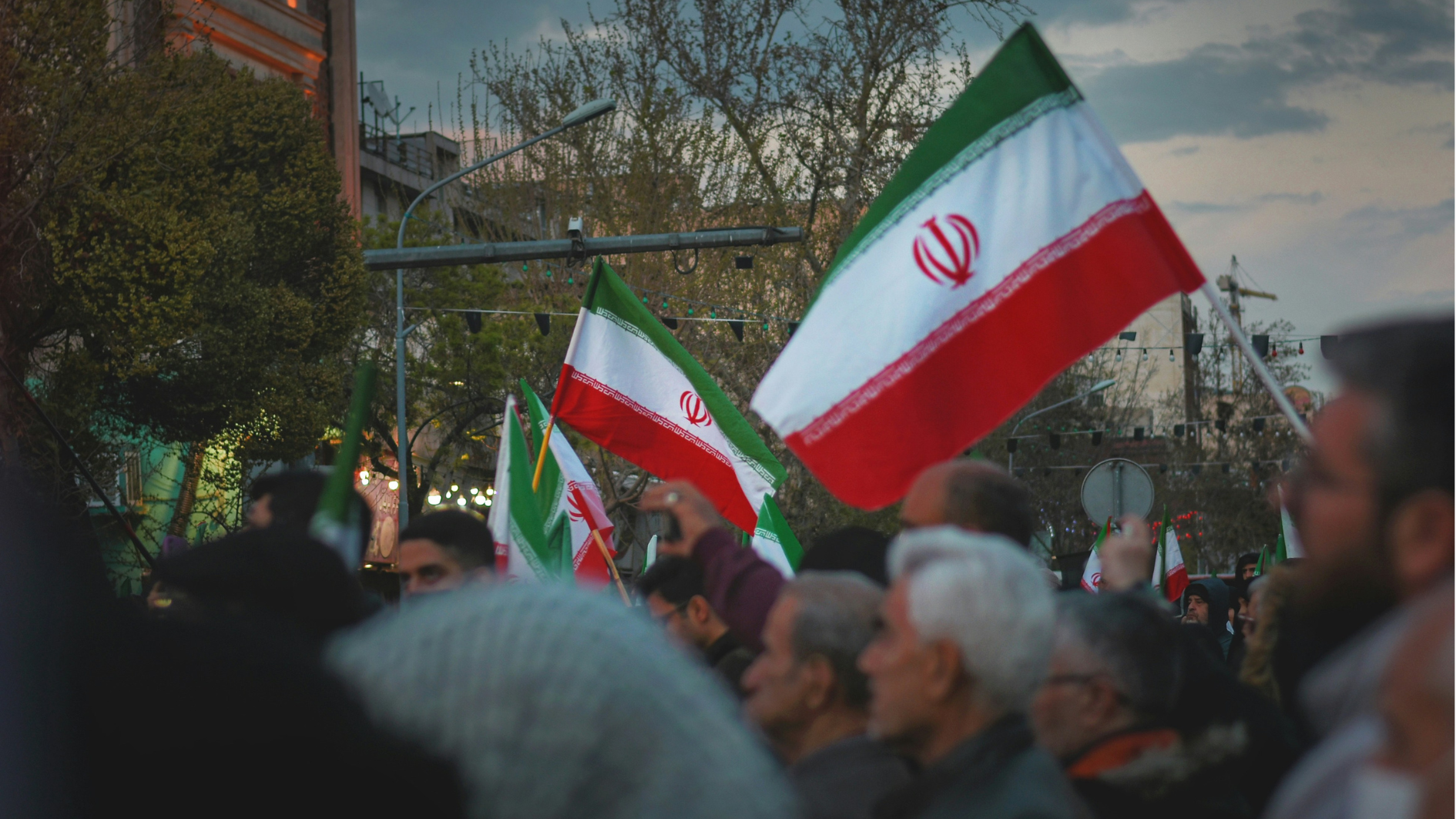
As protests swarmed across Iran beginning in late 2025, the Iranian state cut off people’s access to phone lines and the internet while broadcasting Tucker Carlson on loop on its main TV network. Then Nick Fuentes. Then Hasan Piker. And then John Mearsheimer. The convenience was obvious: the American pundits echoed what Ali Khamenei, a former supreme leader of Iran, had long propagated – that ‘deviant Western liberalism’ corrupts society.
Khamenei is now dead, killed in the opening salvos of Operation Epic Fury in February 2026. But the system he built did not die with him. His son, Mojtaba Khamenei, inherited an Islamic Republic whose guiding ethos had, over the decades since its inception in 1979, become more elastic than ideological: a framework capable of speaking, in different registers, to the global left, the realist right, the conspiratorial far right, and those who imagine themselves outside ideology altogether. What binds these otherwise incompatible audiences is a shared intuition: that liberal universalism conceals elite domination. That power, when turned against the appropriate enemy, can be recast as virtue. The surface shifts. Yet the underlying grammar remains.
The Islamic Republic was, from its founding, a project of moral redescription. Ruhollah Khomeini, the founder of the Republic, did something genuinely radical: he took the thousand-year-old Shia tradition of quietism, the devout patience for the messiah’s return, and abolished it. Waiting became fighting. The Republic became the vanguard of the oppressed (mostazafin) against the arrogant powers (mustakberin). Power exercised in the name of this struggle was not domination. It was duty. Duty to resist. For Khomeini, the shy Shia clergy were no better than the Shah since, in his mind, quietism was the same as being complicit in the domination of the Shah’s regime. The real religious obligation was to resist the global powers that seek to dominate Iran and the Islamic world.
The mantra, ‘resistance,’ drew on a Third Worldist position. It echoed the decades-old dependency theory in political science: development within a system designed to ensure Western supremacy meant perpetual underdevelopment, and the path out required rejecting the world order that supports it. As Michael Parenti, a former defender of the Islamic Republic, once put it in a 1979 New York Times letter to the editor: ‘That anyone could equate the horrors of the Shah’s regime with the ferment, change and struggle that is going on in Iran today is a tribute to the biases of the U.S. press… casting a stern self-righteous eye on the popular revolutions that challenge such regimes.’
Iran’s resistance was framed as the continuation of former prime minister Mohammad Mossadegh’s struggle against the West, in which the 1953 Anglo-American coup which overthrew him in favour of the Shah’s direct rule was inscribed as the founding wound, and the Republic as its belated vindication. Revolutionary Guard–affiliated conferences and universities dressed ideological dogma in the language of international relations theory, multipolarity, the post-American order, and the declining hegemon. America’s decline is divinely ordained, and Iran’s steadfastness is its proof. In this worldview, even episodes such as Iran’s ability to choke the United States through the Strait of Hormuz become more than acts of strategy; they are read as signs that resistance itself bends history in the Islamic Republic’s favour.
What makes this framework distinctive is its capacity to inhabit multiple ideological registers at once without apparent contradiction. The founders of the Islamic Republic drew on Ali Shariati – an Iranian sociologist and revolutionary thinker who fused Shia Islam with anti-colonial and socialist ideas – and his notion of solidarity with the oppressed and strove to create an ‘Islamic Internationale,’ drawing explicitly on Cuban revolutionary internationalism and Palestinian liberation movements. This gave the whole project a socialist genealogy: anticolonial, emancipatory, legible to a global left that had no sympathy for Shia theocracy but considerable sympathy for resistance to American hegemony.
The logic was Parenti’s: you can criticise the Islamic Republic – but to equate it with what came before (the Shah’s Iran), a supposed Western puppet mired in perpetual underdevelopment, its dissidents tortured by a CIA-trained secret police – is a category error, even a form of imperialism. The Shah’s killing of protesters was the evidence. It was a compelling argument for a few months. The Islamic Republic has since killed considerably more of its own people than the Shah ever did. My father, a former communist revolutionary who was imprisoned by both the Shah and Khomeini, always says that the Shah’s prison felt like a five-star hotel in comparison. The sheer brutality of the Islamic Republic in upholding its regime really makes Parenti’s argument look thin.
But the left was only the first constituency. Iran as we know today extends, with equal comfort, into the world of political realism and great power theory. By realism, I mean a tradition in international relations that treats the world as an anarchic system in which states pursue power and security regardless of moral commitments. From this perspective, human rights, democracy, and rules-based order are not neutral principles. They are instruments: tools great powers weaponise to legitimate their worldly dominance. The earlier critique of liberalism framed it as unjust: a system that perpetuates inequality and domination. The next layer reframes it as insincere. Liberal internationalism is not simply wrong; it is a mask. ‘The hypocrisy of liberal democracies,’ as Khamenei put it.
Iranian state media, academics, and Revolutionary Guard–linked think tanks have long had a particular affection for Western scholars who share this scepticism. John Mearsheimer’s offensive realism, with its insistence that states pursue power in an anarchic world regardless of ideology, fits neatly into an Iranian worldview that has always believed liberal internationalism to be a mask for Western hegemony. Jeffrey Sachs, who has argued that Washington’s foreign policy is captured by interests that routinely drag the United States into conflicts against its own strategic logic, is a regular presence on Iranian state television and in regime-friendly media.
The specific claim that Iranian academics, media figures, and state outlets have amplified relentlessly is this: that the United States is not acting in its own national interest in the Middle East, but in Israel’s, pushed there by a lobby whose influence over American foreign policy constitutes a corruption of Realpolitik logic. This is the argument of Mearsheimer – who also believes that an Iran with nukes can balance the power in the Middle East that has been too concentrated in Israel’s advantage – and Stephen Walt’s The Israel Lobby (2007), stripped of its academic qualifications and redeployed as a civilisational grievance.
In Iranian hands, the claim is not that the Israel lobby is powerful and distorting. It is proof of something deeper: that liberal democratic institutions are so captured by particular interests that they cannot even act according to their own rational self-interest. The US went to war against Iran not because it wanted to, the argument goes, but because it was fooled into it. Great Power Theory becomes, in this framing, not just a description of how the world works but an indictment of liberalism’s inability to produce coherent statecraft. It is a tidy argument, and it surfaces openly in official rhetoric Mohammad B. Ghalibaf – the current de facto leader of Iran – attacked US Senator Lindsey Graham directly: ‘[Graham] received millions of dollars from the warmonger Israeli lobby to sacrifice American sons and daughters for Netanyahu’s delusions!’
This sentiment has been echoed repeatedly by the foreign minister and other officials: that the U.S. government has been effectively captured by Israel and made to act against its own interests. It is a narrative that travels easily, especially into far-right spaces where it overlaps with older civilisational claims about hidden control and corrupted sovereignty. The implication follows naturally: just as the United States, General George S Patton claimed, fought the ‘wrong’ enemy in World War II by not also attacking the Soviet Union, it is now, once again, fighting the wrong enemy.
I grew up in Iran. The regime’s flirtation with Hitler and Nazism was familiar to me from childhood, and it persists as one of its many ideological registers. The propaganda of the recent conflict does not openly admire Hitler, but it does not reject him either. It hovers. It signals in one direction while maintaining plausible deniability in another. When pressed, officials reframe such gestures as anti-Zionism rather than antisemitism.This is not new. Former president Ahmadinejad once suggested that 9/11 was orchestrated by ‘Zionists,’ echoing a long-standing conspiracy tradition that collapses geopolitical conflict into covert Jewish control. The same logic is at work in the contemporary ‘antiwar’ Hitler posters. They do not need to endorse Hitler explicitly. They only need to gesture. The signal is received differently by different audiences: for the far right, it flirts with antisemitism; for the global left and realist critics of Israel, it remains just within the bounds of deniability.
The same logic governs the use of phrases like ‘Epstein class’ to describe the Western elites he claims orchestrate policy against Iran by the likes of Mohammad Marandi, who is the Islamic Republic’s most prominent English-language voice. The term is doing specific work. It is not the ‘capitalist class’ or the ‘political establishment.’ It is a story about a group of powerful people who are in cahoots, who reject God, who bow to a false idols. I remember these tropes from childhood being used explicitly to demean and denounce Jews. The framing maintains enough distance for those who did not grow up in that context, or are unfamiliar with this kind of antisemitic esoteric language, to give it the benefit of the doubt.
The regime is not looking for ideological allies in any strict sense. It is looking for narratives that, taken together, construct a world in which every major power would be better off without liberal hegemony: Russia, China, the ‘Global South’, the Western realist who thinks NATO overreached, the nationalist who believes their country is being dragged into someone else’s wars, the leftist who thinks capitalism is imperialism by other means. Iran positions itself as the node where all these grievances converge, the proof of concept for a world that has moved on from Washington.
In this illiberal worldview, Iran gets to present itself as the axis around which a better, multipolar world is already forming. It is also a worldview that Iranian society itself has largely rejected. Surveys from the Group for Analyzing and Measuring Attitudes in Iran have found roughly 80% of respondents in favour of ending the clerical system. The 2025–26 protests produced some of the highest casualty figures in the regime’s history. A government killing thousands of its own citizens for demanding a vote cannot long sustain its identity as defender of the oppressed before this rhetoric turns to ash. Hence why, when the regime cut off the internet in January, it simultaneously broadcasted the American pundits representing both ends of the political spectrum. When domestic legitimacy fails, external validation becomes all the more urgent.
The same logic now extends into the ‘slopaganda’ ecosystem Iran has helped cultivate. The viral AI clips are not meant to be coherent. They are meant to be legible to different audiences at once: Third Worldist grievances through Vietnam and Native American dispossession; realist cynicism through the collapse of liberal order; and, just beneath the surface, older conspiratorial tropes – Epstein Island, Baal, civilisational decay – act as signals to those looking for them while remaining plausibly deniable to those who are not.
This is why the system travels so well. It does not ask for agreement. It offers recognition, and in doing so, turns the information space into a battlefield that Iran is learning to dominate.
The system Khamenei built does not need to win the argument. It only needs to make sure there is no argument left to win.
Kamiab Ghorbanpour is a PhD candidate in cognitive science at Tilburg University. His writing on contemporary politics and culture has appeared in outlets including Wired and Haaretz. He lived in Iran from 1996 to 2019.