
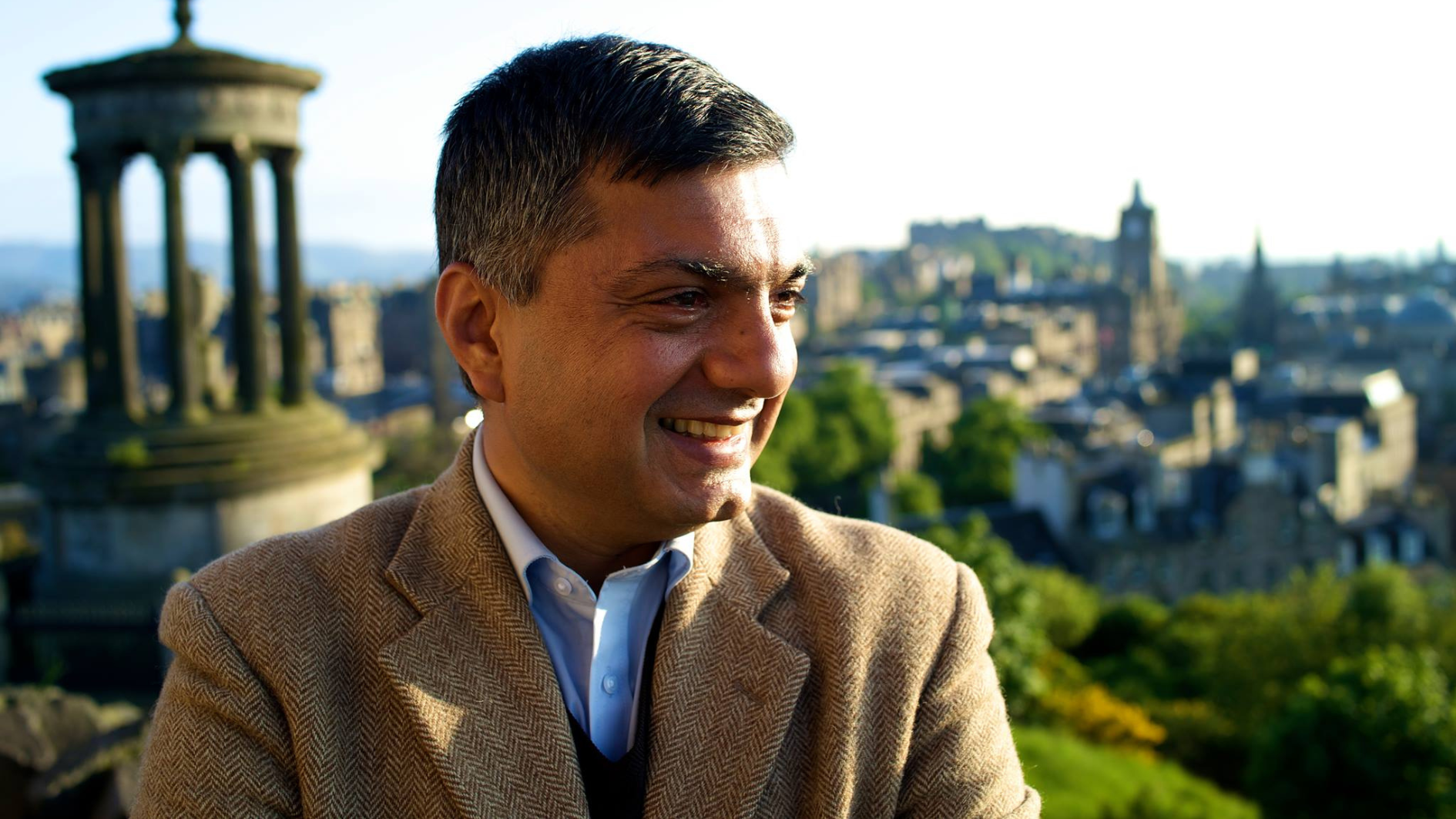
What if the career of Islam as a political subject—an agent capable of acting in history—is coming to an end? Faisal Devji makes this claim in The Waning Crescent: The Rise and Fall of Global Islam (2025), not because Muslims are becoming less devout, but because the conditions that gave Islam its political form have changed. What comes after is the book’s open question. Faisal Devji is the Beit Professor of Global and Imperial History and a Fellow of Balliol College, Oxford. He is the author of Muslim Zion: Pakistan as a Political Idea (2013) and The Impossible Indian: Gandhi and the Temptation of Violence (2012).
Lucas Tse, a historian and a Fellow at All Souls College, recently spoke with Faisal Devji to discuss the book’s argument and implications. The conversation began with the war in Iran, seen against Islamism’s belated rise and decline. Islamism, unlike its colloquial use to denote fundamentalism, is used by Devji to signify the nineteenth century emergence of a ‘revolutionary’ Islam devoid of its theological and metaphysical underpinnings. The interview then turned to gender, specifically Devji’s counterintuitive argument that the refusal of biological difference in Islamic thought produced unexpected consequences for externalised identities and the recognition of non-binary categories in multiple countries. In closing, Devji discussed what might succeed a global political concept when it fades: less a new Islamic movement than a worldwide crisis of the political party as form.
An excerpt of the discussion follows below. The full conversation is available to watch on the Oxford Political Review’s YouTube channel.
Lucas Tse (LT): As we speak, Iran is at war. The state continues to use the language of Islam as a subject, but your book analyses the exhaustion of that political concept. How does your framework allow us to make sense of what’s been going on in Iran in 2026?
Faisal Devji (FD): The book is about the way in which Islam comes to be imagined as a subject in history and of history. It can do things, it can have ideals, it can have a spirit, it can want you to do things. Islamism’s context was the making and breaking of ideological states, particularly during the Cold War, and it couldn’t just survive that context, it changed in various ways.
It’s not like Islamists have ceased to exist, but they are no longer the most important voices and no longer represent the most important movements in the Muslim world or in the world at large. And I’ve always thought, beginning with 2001 as illustrated with 9/11, that the emergence of these militant radical groups – Al Qaeda and then ISIS – really signalled the end of Islamism as a major project. They emerged in opposition to Islamism. They didn’t necessarily want the same kind of ideological states. They weren’t obsessed with imitating the Bolshevik Party as the model for an ideological party or necessarily wanting an Islamic Revolution of the communist kind. And that’s where the Islamic Revolution comes in.
The Islamic Revolution in Iran positioned itself between the East and the West. It looked at the Bolshevik and Chinese revolutions on the one hand and Western imperialism on the other and situated itself in the middle – both geographically but also in some ways ideologically. This was not true for Al Qaeda and later ISIS. The war in Iran is not really a war against Islamism. It’s a war against a government. And it could have been any kind of government. After all, in this larger scheme of things, Iran and Venezuela are on the same boat, as is Cuba.
LT: In your chapter on gender, you challenge the image of purity in a diversified world. You argue that women have become more representative of Islam than men, according to certain movements. What exactly are you observing? When do these categories reflect people’s lives, and when do they not?
FD: Among the ways that women are expected to be more like men is that they are meant to be just as religious. They might not have been expected to be particularly religious in the past. You had autonomous forms of gender belonging and culture. In some parts of India, for instance, there were even specific ways in which women spoke. In becoming part of men’s worlds, they also lose autonomy in other respects. They’re meant to stay at home, not go out, and not hang out with other women. So, in some ways, their lives are much more constrained.
It’s not an atypical story. But the refusal to make a biological distinction leads to very interesting consequences. For the Islamists, in particular, this means sartorial and spatial segregation, in part because you can’t rely on biological difference. Muslim identity becomes externalised in some ways. You have this very interesting reversal. In the diaspora, in the West, or in colonial societies themselves, men or women must be Westernised on the outside, but they can be non-Western in their private lives. Here it’s the opposite, where you must be Islamic on the outside. But in your private life, many more things are open to you.
I have sections in that chapter you mentioned, on intersex individuals, on how the traditional classical language of hermaphroditism presumes that there is not a binary gender distinction. Khomeini himself and the Islamic Republic of Iran set up an extensive set of institutional procedures to manage it. There is a whole battery of psychiatrists and surgeons and therapists who work with people wishing to transition, all of which is paid for and approved by the Iranian government.
LT: If we are witnessing the end of global Islam, as you argue in the book, what do you think that will mean specifically for this fragile, non-biological line between genders?
FD: I don’t see that changing much. It might even become more diversified. Not that intersex or third-gender people are necessarily treated well or even equally, but they do have a status and a recognition in law. When I speak about the ‘ending’ of Islam, its ending means not the end of religious medieval practice, but of Islam construed as a subject of history. I have pointed out three specific forms in the book: the modernist liberals, the Islamists, and then the militants of the early 21st century.
LT: If we are seeing the end of Islam in this form, what are the potential successors that people are putting on the table that you think are worth considering?
FD: I don’t think there’s any one global project any longer. You do have the revival of, for instance, Sufism. If you look at all the most recent great mobilizations of Muslims, their participants might all be very devout Muslims. But none of them take Islam as a subject, which is extraordinary. Neither the Arab Spring, nor any of these protests in Iran, nor these important protests in India a few years ago by Muslims, nor with the fall of the Bangladeshi government. Islam was not important as a subject; it was not invoked.
LT: Are these disparate phenomena, or are there new kinds of connective concepts?
FD: They’re probably connected in some ways. Even where protests have sought to displace governments, as they did in places like Egypt, Tunisia, and most recently in Bangladesh, they have occurred without recourse to political parties and organizations of a traditional kind. They have often been unable, even when victorious in unseating government, to constitute a new kind of state. Whether they will in future, I don’t know. There’s a global phenomenon where the political party is no longer at the centre. How it is to be replaced, no one seems to know. You see the hollowing out of political parties in other parts of the world as well.
I would basically say that what’s happening in Muslim societies is a subset of what’s happening in other parts of the world, politically speaking. The language that defines politics is also changing. We have much more religious language now in the United States and even parts of Europe—Christian language—and Jewish language in Israel. Are they just matching up, finally, to the Muslim world? Or has the Muslim world moved on in another direction and there’s been a kind of exchange of identities or bodies? I don’t know, difficult to say.
The full interview with Professor Faisal Devji is available our YouTube channel.
Image credited to Faisal Devji.