
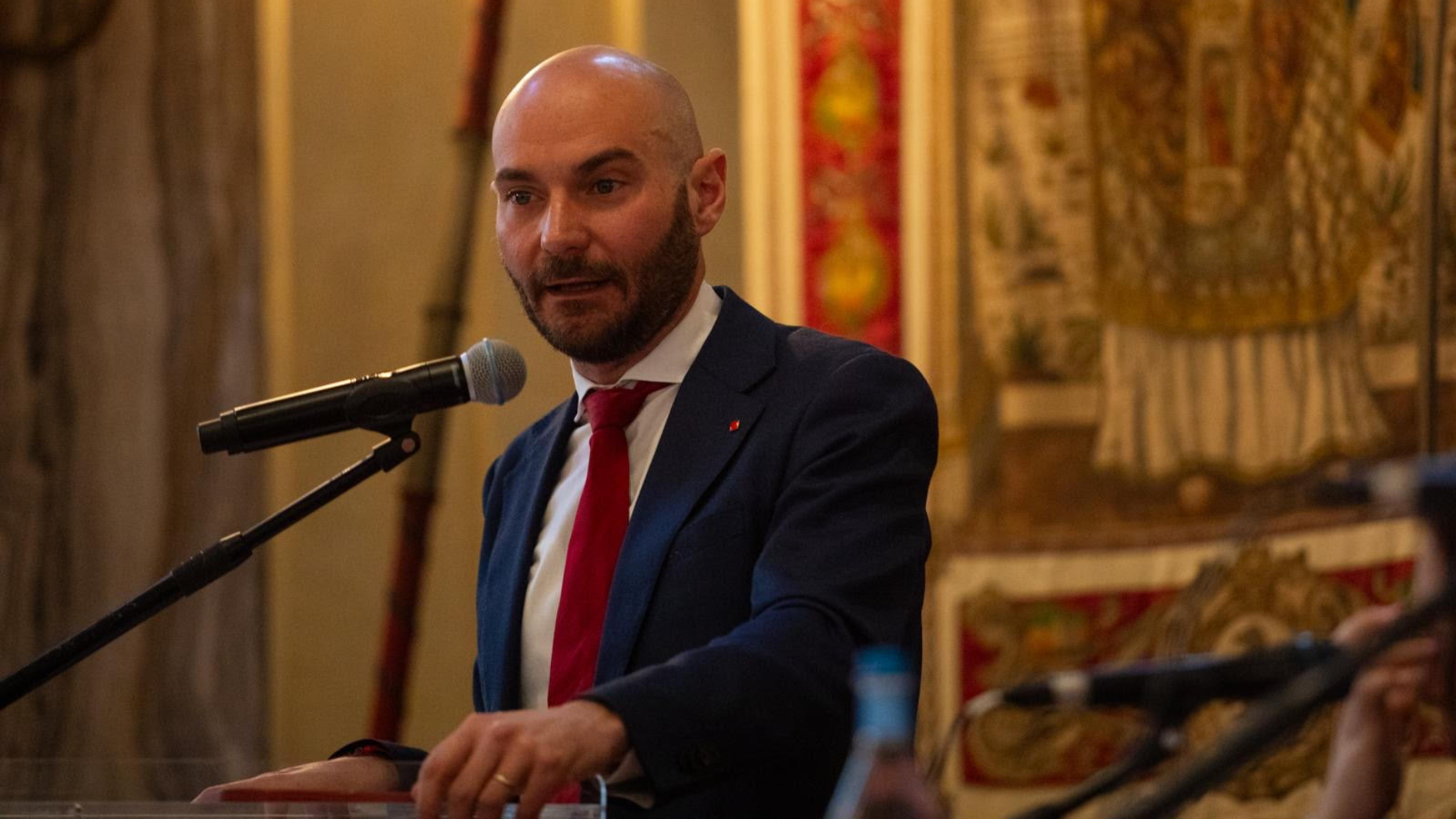
In 2021, ninety percent of Amazon’s workers in Lombardy, a prosperous region of northern Italy, walked out. Their 24-hour strike paralysed deliveries across the country, forcing through the first collective bargaining agreement with Amazon in the world. At the centre of this mobilization was Luca Stanzione, General Secretary of the Italian General Confederation of Labour (Camera Generale del Lavoro, CGIL) of Milan – the capital of Lombardy. With a career spanning logistics, transport, and confederal union leadership, Luca Stanzione rose through the ranks of one of Italy’s most historically significant labour organisations.
In this interview, conducted by Carolina Rota, Stanzione reflects on the trajectory that brought him from student politics to the helm of Milan’s CGIL, and on the broader questions his experience raises for the future of labour representation. He discusses how unions can retain political influence without becoming extensions of political parties, how traditional instruments of mobilisation must evolve in response to platform capitalism and artificial intelligence, and what the Italian confederal model might offer to, and learn from, labour movements elsewhere. Throughout, he returns to the consistent conviction that labour must be understood as an autonomous subject capable of shaping the economic structures that govern everyday life.
Carolina Rota (OPR): Could you explain the stages that led you to trade union activism and eventually to your current role as General Secretary of the CGIL?
Luca Stanzione (LS): My engagement with trade unionism began well before I formally entered the labour movement. From my early years in secondary school, I developed a strong political passion that led me to help build student representation within my institute and to pursue a broader political path within progressive parties. That experience instilled in me the conviction that collective organisation is the most effective way to produce meaningful social change.
The decisive shift came when I entered the workforce. I was employed in a private company, working in planning and management control. During that period, the transport sector in Lombardy was seeking a figure with economic and financial expertise who could intervene in the organisation’s structural conditions. I entered the union initially with a professional and technical role, focusing on organisational and financial matters.
It was in that context that I came to fully grasp the transformative potential of trade unionism. I realised that the union was not merely a representative body, but a collective instrument far more effective than others in improving people’s material conditions. From that point on, I decided to remain within the union. With the exception of a single year spent outside, my professional life has been entirely dedicated to trade union work.
After requesting to carry out union activity on a full-time basis, I was appointed as a union official in Milan, primarily working in transport and logistics. In 2013, I was asked to take on the role of General Secretary of the transport sector in Bergamo, marking my entry into the union’s leadership. I held that position until 2016, when I became General Secretary of the same sector in Milan. In 2019, following a particularly difficult moment for the national transport federation, I was appointed Regional General Secretary of the Italian Federation of Transport Workers in Lombardia. Most recently, I was elected as General Secretary of the Italian General Confederation of Labour.
OPR: Was there a particular moment, encounter, or experience that reshaped how you understand work and representation?
LS: If I had to identify a defining experience, it would not be a single episode but a collective challenge: the unionisation of Amazon. This was a turning point not only for my own understanding of representation, but for the history of contemporary trade unionism. Amazon is one of the largest multinational corporations in the world and reportedly spends around 25 billion dollars annually to prevent unionisation across its global operations. Against this backdrop, Lombardy became the first place in the world where a confederal trade union successfully established a stable presence within Amazon, with Milan at the centre of that breakthrough.
Today, approximately one out of every two Amazon employees in Italy is unionised. This result was accompanied by repeated mobilisations and several collective agreements that materially improved working conditions. Its significance lies not only in the outcome itself, but in the fact that it contradicts a dominant narrative about logistics as a sector defined exclusively by precarious work and low union density.
This success did not emerge suddenly. Since the early 2000s, when logistics progressively replaced other manufacturing sectors, we consciously chose to organise within warehouses as they expanded. As logistics grew, so did union membership and representation. In Lombardy, the confederal unions, including CGIL, remain strong actors in the sector. The Amazon victory is therefore the culmination of a long-term strategy, though its symbolic impact has been enormous both nationally and internationally.
Amazon’s relationship with Italian trade unions stands in stark contrast to its power in other countries. In the United States, despite high-profile campaigns in Alabama, and New York City’s Staten Island, unionisation has faced fierce corporate resistance and fragmented institutional support. The Amazon Labor Union’s 2022 victory at the JFK8 Fulfillment Center in New York was historic, but is far from representing a consolidated confederal presence across the sector. By contrast, recent developments in Canada, including its general trade union Unifor’s successful efforts to secure representation rights in parts of Amazon’s operations, illustrate that breakthroughs are possible where unions combine legal strategy, grassroots organising, and public framing around workplace safety and dignity.
Pepper D Culpepper and Katharine Thelen’s work on businesses’ power helps explain that these victories are rare because companies like Amazon derive legitimacy directly from consumers, which insulates them from the public pressure that unions mobilise. When this consumer-platform alliance is strong, organising efforts face additional obstacles, as public discourse often frames regulation or unionisation as a threat to convenience and efficiency. By that point, the workforce is also significantly larger and more spread out, and the company’s political standing is far harder to challenge. The Italian labour union CGIL succeeded because it organised before Amazon reached that position of strength, moving while there was still room to build power.
OPR: The CGIL is often described as a political actor, even though it is not a political party. How does the union influence the political agenda today, and can you point to a recent case where union pressure altered public decision-making?
LS: The CGIL is indeed a political actor, but its political role is distinct from that of parties. It intervenes in politics through representation, mobilisation, and the articulation of collective interests rather than electoral competition.
This role is deeply rooted in Italian history. The confederal model of trade unionism emerged in the early twentieth century, drawing on earlier traditions of organised labour and later shaped by socialist thought, which introduced the working class as a conscious and organised subject of history. Even during moments of rupture, such as fascism or post-war political realignments, the union consistently defended its autonomy from party structures.
A clear contemporary example of our influence occurred in 2016, when the CGIL launched a referendum campaign against labour laws that had significantly worsened working conditions, particularly for younger workers. Faced with the prospect of a popular vote, the Government and Parliament intervened to amend those laws, partially reversing their most harmful effects. While the reforms did not fully meet our demands, this episode demonstrated the union’s capacity to reshape the political agenda through democratic pressure.
OPR: How does the CGIL navigate its relationship with political parties, especially in a context of declining political participation?
LS: The relationship between trade unions and political parties in Italy has always been complex and dialectical. Historically, there have been moments of alignment and moments of open divergence. A pivotal example is 1956, when the CGIL, under Giuseppe Di Vittorio, publicly distanced itself from the Italian Communist Party following the Soviet invasion of Hungary. That decision reaffirmed the union’s autonomy and its responsibility to workers rather than to any party.
Today, political parties face a profound crisis of participation and social rootedness. This affects the union as well, but in a different way. If we look at elections for workplace representatives, participation often exceeds 80 or even 90%. The union continues to be recognised as a legitimate representative of workers’ interests, even as parties struggle to maintain similar levels of engagement.
Our role is therefore not to substitute political parties, but to ensure that labour remains central to public debate. We regularly put forward proposals, for example on income taxation and fiscal drag, that affect workers across political divides. Parties may propose policies for workers, but they often fail to recognise labour as an autonomous social subject. That is the space the union continues to occupy.
OPR: How does the CGIL decide when to deploy different instruments, like general strikes, sectoral mobilisation, alliances, or negotiation?
LS: There is no fixed formula. Every decision is based on a concrete assessment of the balance of forces at a given moment. In individual workplaces and sectors, strikes and collective bargaining remain effective tools. Negotiations produce agreements, and those agreements can be verified over time.
However, at the level of the confederal union, these traditional instruments are increasingly insufficient to influence national policy. In recent years, we have observed that general strikes alone have not always succeeded in shifting government agendas. This is why we have turned again to referendums, as we did in 2016 and more recently in 2024–25.
At the same time, we are engaging in an internal reflection on the need to rethink our instruments of mobilisation. For instance, we have made limited use of collective legal actions focused on workers rather than consumers. Exploring new tools, including strategic litigation and broader forms of collective action, may be necessary if we are to remain effective in the current political and economic context.
OPR: Turning to technology, how does the CGIL assess the impact of automation and artificial intelligence on employment?
LS: The immediate impact of artificial intelligence and automation is being felt most strongly by a middle segment of the workforce, neither low-skilled manual labour nor top management, but intermediate professional roles. This transition is not automatic; it depends on corporate strategies and political choices.
We already encounter disputes where workers are dismissed without explicit justification, even though the underlying cause is clearly technological substitution. Addressing this requires a much stronger public role than we have seen in the past two decades. The idea that the state should not intervene in labour market dynamics has proven inadequate.
In Milan, for example, the telecommunications sector is projected to lose around 5,000 jobs by 2029. At the same time, new investments, such as Amazon’s data centres, are expected to create a similar number of positions. Without public coordination, displaced workers will be left to navigate this transition alone. With an active public actor, retraining and redeployment could turn technological change into a governed transition rather than a source of fear and exclusion.
A central argument as presented by Stanzione is that the retreat of the state from labour market intervention has proven inadequate. Stanzione argues that without active public coordination, workers will face technological transitions alone. We can already see the consequences of this lack of support. As reported by Corriere della Sera, Milan prosecutors placed food delivery company Glovo under judicial supervision as part of an investigation into alleged labour exploitation involving tens of thousands of riders. The case centres on the company’s platform-based management model, where riders are formally classified as self-employed but are managed and monitored through the app’s algorithmic systems. This reflects Stanzione’s core argument that technology itself does not determine outcomes; rather, it is the way companies design and deploy digital systems that shapes labour conditions.
Carolina Rota (OPR): What aspects of the Italian confederal union model might be useful beyond Italy, and what can Italian unions learn from other contexts?
Luca Stanzione:
Trade union models are deeply shaped by their historical, social, and political contexts, and they cannot simply be exported. That said, if Europe were to develop a genuinely confederal trade union model, it could significantly strengthen workers’ capacity to influence economic and political decisions at the continental level.
Europe today is fragmented and often unable to respond collectively to global economic pressures or strategic choices, including the growing orientation toward a war-based economy. A strong European confederal union could help rebalance these dynamics and defend social and productive systems.
At the same time, Italian unions have much to learn from struggles elsewhere — particularly from contexts where workers lack formal protections and must rely on innovative forms of organisation. Studying these experiences is essential, not to replicate them mechanically, but to enrich our own strategies. Ultimately, the goal remains constant: to recognise labour as an autonomous, thinking subject capable of shaping the economic structures that govern people’s lives.
Beyond this perspective, it is worth noting that recent developments in EU labour law partially reflect the tensions described above. The 2022 Directive on Adequate Minimum Wages seeks to strengthen collective bargaining coverage across Member States, explicitly linking wage adequacy to the vitality of social dialogue. More recently, the 2024 Platform Work Directive introduces a rebuttable presumption of employment for many platform workers, potentially extending labour protections to sectors historically characterised by precarity and legal ambiguity. Lastly, the European Parliament and the Council of the European Union have adopted a new directive on European Works Councils. This development represents a significant step toward the EU’s objective of strengthening the role of European Works Councils (EWCs) in multinational companies operating across states in the European Union and European Economic Area. Building on the European Commission’s 2024 proposals and following extensive negotiations, the revised framework, once formally enacted, will introduce a range of important reforms aimed at enhancing workers’ rights to information and consultation at transnational level.
While these measures do not amount to a fully confederal model of trade unionism, they signal an evolving recognition at the EU level that labour must be institutionally empowered to respond to cross-border economic restructuring.