
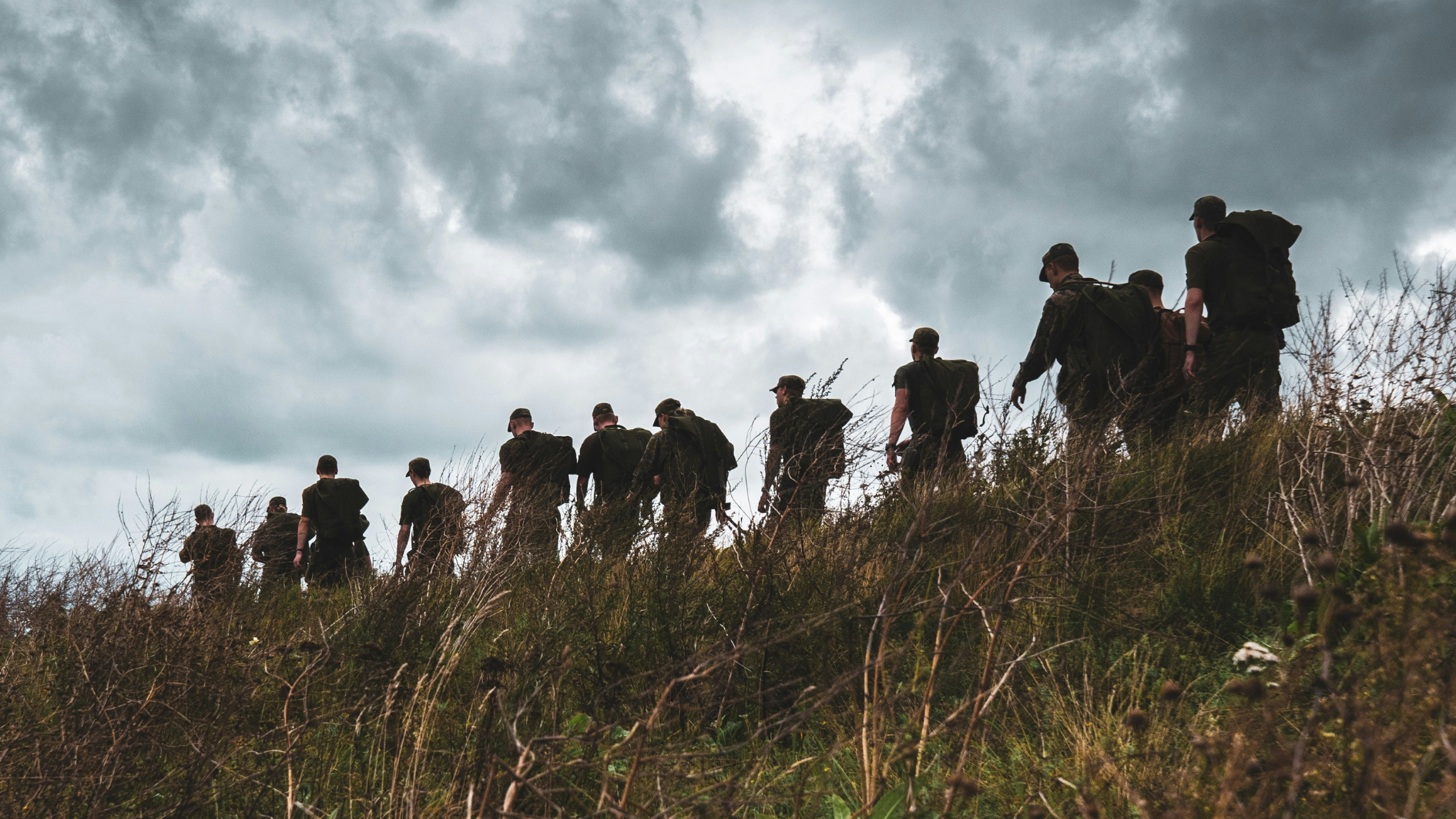
Though unfamiliar to those lucky enough to avoid it, conscription looms large for many as an inevitable part of early adulthood. Being a Korean man, this was the case for me – on a random Thursday last August, I left behind two years of my life as a university student in the UK and enlisted in the Korean Army.
At the risk of sounding blindingly obvious, conscription is hard. Being a soldier is itself difficult: in my case, I was packed into a 5-by-7 meter square room with eleven others, suffering daily through vigorous physical exercise, verbal abuse, and an organisational structure so controlling that relieving yourself requires the approval of a superior and two of your peers to escort you. In a conscript army, this is amplified by the simple fact that no one – not me, nor my bunkmates, nor even the drill sergeants – chose to be there.
I admit to occasionally feeling some amount of the martial solidarity often seen in the movies. Shared suffering of any kind tends to have that effect. But most of the day to day was overwhelmingly negative. Besides the obvious physical and mental strain, I was tormented by life before conscription. What hurt most were memories of the mundane: the station announcements on the train to Paddington, the way tables in Wetherspoons pubs always seem to be slightly sticky, friendly chats on familiar couches. Though I had grown up in Korea, Britain was where I first experienced adulthood, and whenever these memories surfaced, I was reminded that things would never quite be the same. The world would irreversibly move on in my two years of involuntary absence. It was really this mental strain that was the most unbearable.
Yet, by complaining about the time I spent in the military I risk sounding overdramatic. I am one of the lucky few who ‘have it easy’– having been disqualified from active service, I was discharged after a perfunctory three weeks in basic training. Instead, I serve as a civilian care worker and enjoy such privileges as a commute and the freedom to write this essay in my spare time. Korean readers, especially those who have served properly, will be wondering why I am making such a big deal of this when all men have gone through what I have, many in much worse circumstances.
It is precisely this banality and the effect it has on my society that I want to discuss here. Despite the huge sacrifices demanded of young men, the Korean attitude on the draft has in my experience been nonchalant. For such an old and all-encompassing system, this is somewhat inevitable: there is no use complaining about something so universal and doing so risks being seen as whiny. This is not to say Koreans are unsympathetic to conscripts, far from it. I received plenty of well wishes, many from those who had it much worse. However, there is a natural limit to how much empathy society can have for those performing a duty so normalised.
Comparing the reactions I received from my Korean and British friends on news of my conscription reveals the difference in societal attitudes. From overseas I was sent heartfelt, almost embarrassing paragraphs on how I would be missed and the injustice of it all; from the Korean side came mostly comments about how funny I looked without my hair. This is not to cast aspersions on my Korean friends– in the previous year, I had made fun of them in exactly the same way, and when one had called me in a panic the night before enlisting, I spent most of the call explaining that year’s Eurovision.
Being a soldier is often romanticised. Service is supposed to engender solidarity: both for the nation, through fostering a sense of duty, and with your comrades, through the overcoming of shared hardship. This has an element of truth to it. Shared hardship does tend to bring people together, if only because you are stuck with whoever you are stuck with in the barracks, and getting by requires some degree of cordiality. You do also grow closer incredibly quickly when the training is particularly rough.
This is, of course, assuming the best-case scenario. Being forced into tiny rooms with men from all backgrounds, there is just as much of a chance that you will run into any number of objectionable personalities, from mildly annoying to borderline criminal. Even pretending that the military is this wonderful, romantic place of solidarity cannot make the fundamental grievance go away, because being forced to do something is itself a bitter pill to swallow. No matter how you put it, the fact is that you are being forced to sacrifice two years to a life of stress and physical labour, and the only alternative is jail time, a criminal record, and social ostracisation.
It’s therefore understandable and even obvious why this would make many feel betrayed and angry. Yet Korean society does little to assuage these emotions beyond empty pleasantries and a pat on the back. I do not think this is out of malice nor even any conscious disregard for the military. Rather, the lack of recognition is a natural result of conscription being a regular fact of life. However inevitable, this indifference turns conscripts away from healthy coping mechanisms and onto online spaces, where they are free to vent anonymously. It is there that emotions fester and turn into bitter rage.
Conscription-related outrage has periodically breached the Korean zeitgeist. One of the earliest instances was in 2010 when an online tutor called men ‘violent’ because they ‘learn to kill in the military’. Though the tutor was promptly sacked, the incident is still frequently discussed on social media. Controversies big and small persisted: outrage was provoked in 2015, when users of an online forum suggested boycotting Starbucks because they gave away free coffee to conscripts; in 2019, when an audience member on a debate show called soldiers ‘murderers’; and in 2021, when a high schooler sent an insulting letter to a soldier as part of a school assignment.
Though these incidents often involve genuinely offensive behaviour towards troops, the scale of the reaction is almost always blown out of proportion. The online forum discussion did not lead to a boycott. The debate show incident involved an audience member, not a professional panellist. The insensitive letter was one out of many others that were perfectly respectful. That these relatively minor incidents led to massive backlash on social media and eventually mainstream news coverage reflects the pent-up anger felt by many men towards those who do not respect their sacrifice, especially towards those who did not themselves serve.
Crucially, this anger is directed mainly at women, who do not take on the burden of national service and therefore enjoy a two-year head start in their early career. Forums like DCInside and FMKorea – each of which boasts a larger userbase than Instagram in Korea – channel men’s anger from this perceived disrespect for service into rampant misogyny. One popular meme called the Gyejip Shinjo (the ‘Bitch Code’) parodies the Army’s code of conduct by listing rules women should follow, including ‘unconditional obedience to men’ and ‘staying in the kitchen.’ At the peak of its popularity this was so widespread that schoolteachers were expressing alarm at teenage boys openly reciting the code to their female classmates.
Politicians have been quick to exploit this trend. In the 2022 presidential election, young men voted overwhelmingly for Yoon Seok-yeol, who had pledged to abolish the Ministry of Gender Equality, long a favourite punching bag of the online right. In the latest presidential election, they disproportionately voted for a third-party candidate, Lee Jun-seok, a young conservative who built his reputation on debating feminists. A vivid flashpoint of this campaign came during the presidential debate, when he described in graphic detail a hypothetical rape scene involving chopsticks. Combined with those who voted for Kim Moon-soo, Yoon’s successor candidate, the right wing enjoyed a staggering 74% share of the vote from men in their 20s.
The rise of the antifeminist right is alarming in a country that has already exhibited a tenuous record on women’s rights. South Korea’s gender pay gap is the highest in the OECD, while senior managerial positions are still dominated by men. Menstrual and maternity leave remain a contentious issue in the workplace. Korean schools have been facing a deepfake pornography crisis. In a country with the lowest fertility rate in the world, political polarisation along gender lines has serious implications for the population as a whole.
There are, of course, many reasons for this political climate, but I believe the callous way in which society dismisses the legitimate grief caused by conscription is one that has been underappreciated. Though by no means do I want to absolve young men of the responsibility for their misogyny and extremism, nor attribute all polarisation to conscription, there is a reason that conscription-related outrage resurfaces on an almost annual basis. While the individual incidents may be insignificant, for young men, each new case serves as confirmation of their overarching narrative of victimhood and marginalisation.
What many young men see as malice is most likely mere indifference. From the perspective of those who do not experience conscription, or did experience it decades ago, it is all too easy to dismiss it as an interesting, albeit unfortunate, episode in life. It can also be difficult to ask that we consider the plight of young men facing conscription when Korean society remains deeply patriarchal and, at times, explicitly oppressive to women and minorities.
Still, my appeal is that we must look beyond our own grief to empathise with the other side, even if they may be ideologically reprehensible. There is often an underlying grievance within these movements which, if left unaddressed, allows extremism to germinate. In Korea’s case, identifying this is straightforward: conscription is highly visible and contentious. If the goal is to stop extremism, there has to be reconciliation, and reconciliation necessitates acknowledging, empathising with, and making a genuine attempt to address these feelings, even if – as in the case of conscription, the grievance is deemed necessary for the greater good.
Being drafted has allowed me to experience what leads so many of my peers to extremism. Having empathy for strangers is hard, even for the best of us. Even properly caring for friends is sometimes difficult. I confess to not paying nearly enough attention when my friends enlisted– I was not personally staring down the barrel of conscription, and I was far too occupied with a new life in a new country, Eurovision and all. But however difficult, we must extend our solidarity to everyone, because the political extremism we are suffering now is a consequence of the indifference of years past. I am not so naïve as to think that solidarity alone will solve polarisation, but it is clear to me that it is the basic foundation upon which all other social progress is built.
Jae-Hyun Jo is a social worker fulfilling mandatory national service at a childcare facility in Seoul, South Korea. He was previously a Politics and International Relations undergraduate at the University of Bristol.