
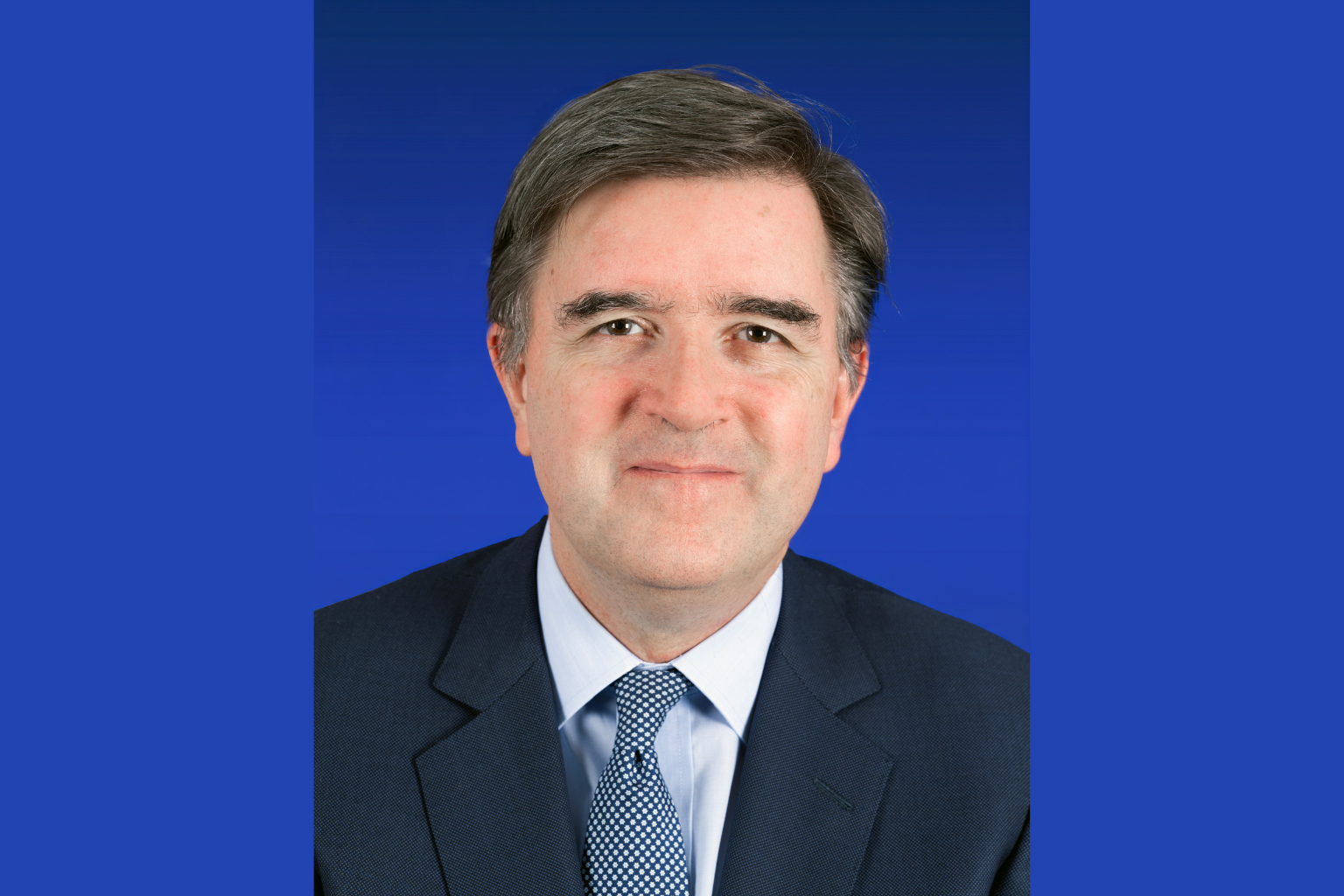
Amid increasing pressure on Europe to defend itself, and as President Donald Trump continues to present himself as a peace-deal negotiator in the Middle East, the OPR’s Elena Sofia Massacesi interviewed US diplomat James C. ‘Jim’ O’Brien, former Assistant Secretary of State for European and Eurasian Affairs during Joe Biden’s presidency.
Prior to his role in the Biden administration, O’Brien served as head of the Office of Sanctions Coordination and as the Special Envoy for Hostage Affairs under President Barack Obama. He was also a career official at the US Department of State from 1989 to 2001, serving in the Office of the Secretary, Policy Planning Staff, and the Office of the Legal Adviser. He later served as presidential envoy for the Balkans, where he was involved in managing the 1995 Dayton Agreement that ended the Bosnian wars. Outside government, O’Brien cofounded the international advisory firm Albright Stonebridge Group (ASG), where he served as vice-chair. He is currently a distinguished visiting fellow at the European Council on Foreign Relations and a Fellow at the Institute for Human Sciences in Vienna.
Changes in European Spending
The discussion opened with strategic autonomy and whether European attitudes towards increased defence spending had shifted following the 2025 North Atlantic Treaty Organisation (NATO) summit in The Hague. O’Brien said that they had, and outlined three reasons.
First, US pressure on the European Union to increase defence spending is longstanding. O’Brien recalled that, from 2014, successive US presidents pressed European allies to raise spending to 3.5% of GDP, against a European average of 1%. These discussions culminated at the 2024 Washington Summit, which produced the first revised defence plans since 1989, albeit with limited public coverage. Trump’s call for a 5% target, however, brought the issue to the forefront of debate. O’Brien argued that the 5% figure builds on the 3.5% benchmark by incorporating the infrastructure investments NATO requires to deploy and operate its assets. For example, he pointed to Germany’s Leopard II tanks, which cannot travel on the autobahn because many bridges are unable to bear their weight.
Second, O’Brien argued that shifts in contemporary warfare are prompting states to reconceptualise defence spending as an investment in innovation. The rapid diffusion of uncrewed systems, including drones, has altered the nature of combat; as the Guardian reported, experts estimate that drones now contribute to about 70% of military casualties in the war in Ukraine. O’Brien therefore argued that states increasingly recognise that military spending cannot focus solely on subsidising domestic industry, but instead, ‘has to be delivering a capability, but that capability increasingly is an innovative one, because we are looking at a battlefield that is very different than what it might have been ten years ago. And that, I think, has helped a lot of European states recognise the importance of investment in their defence industries.’
Third, O’Brien suggested that the unpredictability of President Donald Trump’s administration has prompted NATO to reassess its reliance on the US for security guarantees. He said the uncertainty reflects not only Trump’s inclination to reopen settled questions, notably the Joint Comprehensive Plan of Action (JCPOA) on Iran’s nuclear programme, but also divisions within the Republican Party, which is split between those prioritising Asia, those advocating a focus on Latin America, and a third camp favouring isolationism. In O’Brien’s view, this volatility requires a different approach to US–EU engagement, in which Washington no longer exercises the degree of influence over European states that it has enjoyed over the past 80 years.
O’Brien envisaged a future in which Europe undertakes a ‘reassignment of burdens’ in protecting itself against the Russian threat along its eastern border. He argued that, as China places greater emphasis on projecting power in southeast Asia, and as tensions involving Korea and Japan persist, the United States will increasingly focus elsewhere, rather than on Europe. He also described this shift as an economic opportunity. Drawing an analogy with the 1880s–1890s, when railways, telecommunications, and fossil fuels were first integrated into economies, he suggested that the digital revolution will be followed by a period of adjustment:
going to be a big hangover. But coming out of that, I think prosperity over the next couple of generations will be decided by how well our societies manage artificial intelligence, the energy transition, developments in life sciences, and I’d add defence as an innovative space. So, if we do those things well, I think our societies will be stable and prosperous.
The key, he said, is to make those investments together.
The former diplomat emphasised that, while China is highly populous and economically powerful, Western countries can match its scale and wealth. ‘We know how to write the rules for global commerce. That’s something we need to do together. Security is just the bedrock on which that foundation stands,’ he said. In his view, once security responsibilities are reassigned, the priority should be to ensure that Western countries continue to set global standards, rather than ceding that role to China.
Russian Gas, Green Transitions, and Ukraine
We then turned to Russian gas and Europe’s green transition. Could a lack of sustained European commitment give Russia an advantage in restarting its gas supply? O’Brien suggested that it would be difficult to reverse European states’ shift away from Russian energy after the invasion, ‘because they don’t need the same level of gas and even oil that they were getting from Russia before. If the transition to renewables and alternative energy, and especially battery storage, were going very smoothly, then I think Russia would have even less opportunity.’ He also cautioned against underestimating the impact of technological change, not least because the growing availability of energy-storage devices addresses one of renewables’ main drawbacks.
Drawing on his experience as former head of the Office of Sanctions Coordination, we discussed the effectiveness of US sanctions and EU gas decoupling in limiting Russia’s capacity to prosecute the war in Ukraine. O’Brien stressed the importance of maintaining decoupling, not least because European states have, so far, resisted pressure to return to Russian gas, thereby constraining Russia’s war financing. Nonetheless, sanctions and decoupling measures are only effective if they are enforced, and Russia has already begun to evade them through proxy and front companies. O’Brien highlighted shipments transiting the Baltic Sea and the North Sea. This, he said, ‘creates a real opportunity for that group of Scandinavian and European states, including the UK, to restrict that flow and make sure that it’s in accordance with sanctions.’
As Western countries have cut Russia off from supplies of chips and semiconductors, Moscow has turned to other partners. ‘Russia would not be fighting if China had not begun to provide the inputs for battlefield items, for weapons and delivery systems and the like. They’ve also relied on artillery shells from North Korea and then the design help from Iran,’ O’Brien said. However, he argued that these partners are a more unstable set than those in the West, not least given Iran’s limited ability to project power in its own region and North Korea’s status as a hermit state. Even in its relationship with China, he added, Russia ‘now has to face up to the fact that it is the minor partner in a relationship with China. And I think that’s uncomfortable. Putin went to war for respect. He wanted to be one of the three or four continental powers that decide issues around the world. And he’s emerging from this war without the same influence he had in Europe.’
Peace Agreements
O’Brien assisted in negotiating the Dayton Agreement, the 1995 accord that ended the Bosnian War and established the country of Bosnia and Herzegovina. Although the agreement remains in force, it has not been without flaws, not least its inadvertent entrenchment of the ethnic divisions that initially animated the conflict. As O’Brien put it:
Dayton’s strength is its weakness. It was a ceasefire between three armies. And the armies insisted that if they were going to stop fighting, that they would get political power to replace what they had on the battlefield. That led to what was a sort of Yugo-nostalgic structure of government, with three constituent peoples having special voting rights and special separate constituencies.
In practice, he argued, candidates are incentivised to campaign as representatives of their national group, which can deepen intra-state tensions and sit uneasily alongside the contemporary European emphasis on citizenship and individual rights.
He further suggested that the challenges created by entrenched ethnic politics are compounded by economic transition. Many countries in the region are still grappling with the shift from socialist to market-based economies; within the Yugoslav institutional legacy, O’Brien noted, political leaders can entrench their position through access to state resources, including appointments to state-owned enterprises and public-sector jobs as well as the allocation of public contracts. He contrasted this with the development of European states in the mid-1800s, which, he argued, was driven in part by the emergence of more impartial bureaucracies that administered public systems and remained insulated from direct political control. ‘I think we missed that in Dayton,’ he reflected. ‘It’s something I would watch for very carefully in any other peace agreement. But, you know, the difficulty is how do you provide warring parties with enough confidence that they will stop fighting, but also the ability to have the politics change over time.’
Turning to the prospect of a lasting peace agreement between Israel and Gaza, O’Brien identified two requirements for any durable settlement.
First, security provisions. As he put it, ‘setting aside arguments about Hamas and elsewhere, Gaza is a place where there are lots of young, angry men with guns, and you’re asking ordinary citizens to go back and rebuild in that environment. Somebody has to come and provide ground-level security. In Bosnia and Herzegovina, it took us about six to ten months after the agreement to have a more effective way of just providing ordinary daily security on the ground. And I don’t think they have answered that question yet in Gaza.’
Second, ensuring that ordinary citizens in the affected communities have a voice, through direct engagement to understand what they need and what they want. O’Brien noted that Western media often focuses on speaking to Israel or the Palestinian Authority, which has limited authority in Gaza. He contrasted this with Northern Ireland, which, he said, ‘put a huge emphasis on having the negotiators engage with their respective communities on a daily basis so that there were no surprises and that every step taken had the support of the community. And I think they did that more directly than we did in Bosnia.’ As with the Dayton Agreement, Northern Ireland’s governing arrangements were designed to ensure that different communities had their own voice, yet society has been able to move beyond the conflict.
Advice for Aspiring Diplomats
Finally, the OPR asked O’Brien what advice he would offer to young professionals seeking to enter his line of work. He began by emphasising that diplomacy is a career in its own right. A lawyer by training, he said he joined the US Department of State ‘without a clear sense that I wanted or even knew how to have a career doing foreign policy’. He attributed much of his professional development to flexibility: ‘every career is kind of arbitrary. You get to work on an issue or with someone who is in a position to bring you along or teach you things, and that creates opportunities.’ Those opportunities, he noted, may not be the ones you anticipated. O’Brien began at the Department of State ‘ten days before the fall of the Berlin Wall. That wasn’t on the cards at the time I began.’
Turning to practical guidance, he argued that beyond formal credentials, it is specialist expertise that most reliably advances a career. ‘Look at the leadership of the organisation you want to join and see who they have in the room when there’s a crisis. And typically, whether it’s a CEO or a minister or someone, they will have a set of people with particular skills in the room […] What you don’t tend to see are people who build really good careers just because they’ve been a smart person in the room.’ In his view, aspiring professionals should aim to bring ‘a foundation that gives you a reason to be in the room’. Only then, he said, can you move beyond the limits of a narrow professional role and demonstrate that you understand a crisis in the round: ‘but the first step comes by actually knowing something’.